
Creating a Foundation
THE 3 C’S OF COMMUNICATION
Community → Contact → Customer → Cheerleader
LESSON 1: Why Your Organization Needs a Communication Plan
Welcome
Every business and every nonprofit is already communicating — whether or not anyone planned it that way. The question this training answers isn’t whether you communicate. It’s whether your communication is working for you or happening to you.
This training is built around a simple framework: the 3 C’s. It describes the three shifts every relationship has to make before someone becomes a lasting supporter of your organization — whether that relationship ends in a sale, a donation, a membership, or a referral. Before we walk through each shift in later lessons, Lesson 1 makes the case for why you need a deliberate plan to make those shifts happen at all.
Learning Objectives
1. Explain what a communication plan is and what it is not.
2. Identify the hidden costs an organization pays when it communicates without a plan.
3. Preview the 3 C’s framework and how it will structure the rest of this training.
4. Recognize why this framework applies equally to for-profit businesses and nonprofit organizations.
5. Begin an honest audit of your own organization’s current communication habits.
The Problem: Communication Without a Plan
Most small and mid-size organizations don’t lack communication — they lack coordination. A social media post goes out with one message. An email newsletter says something slightly different. The person answering the phone says something different still. None of it is wrong, exactly. It’s just not pointed anywhere.
Without a plan, communication tends to default to being:
Reactive — driven by whatever came up this week, not by what moves people forward.
Inconsistent — different messages from different people, channels, or campaigns.
Front-loaded — heavy effort to attract attention, with almost nothing built to keep it.
Owner-dependent — it works only as long as one person remembers to do it.
Unmeasured — no way to tell which efforts actually built relationships and which didn’t.
None of this means the people running these organizations are careless. It means communication got treated as a task to complete instead of a system to design. A plan is what turns a series of disconnected efforts into a system.
What a Communication Plan Actually Is
A communication plan is not a content calendar, a slogan, or a marketing budget — those are outputs of a plan, not the plan itself. At its core, a communication plan is a deliberate answer to four questions:
Who are we trying to reach, and where are they right now in their relationship with us?
What do we want them to think, feel, or do next?
What message and channel will move them there?
How will we know it worked?
Answered once, in writing, and revisited on a schedule, these four questions replace guesswork with a repeatable process — one that a new employee, board member, or volunteer can pick up without having to read your mind.
Introducing the 3 C’s Framework
This training organizes every relationship your organization has around three sequential shifts. Each one requires a different kind of communication, which is exactly why a single, undifferentiated approach — “we post on social media and hope” — tends to underperform.
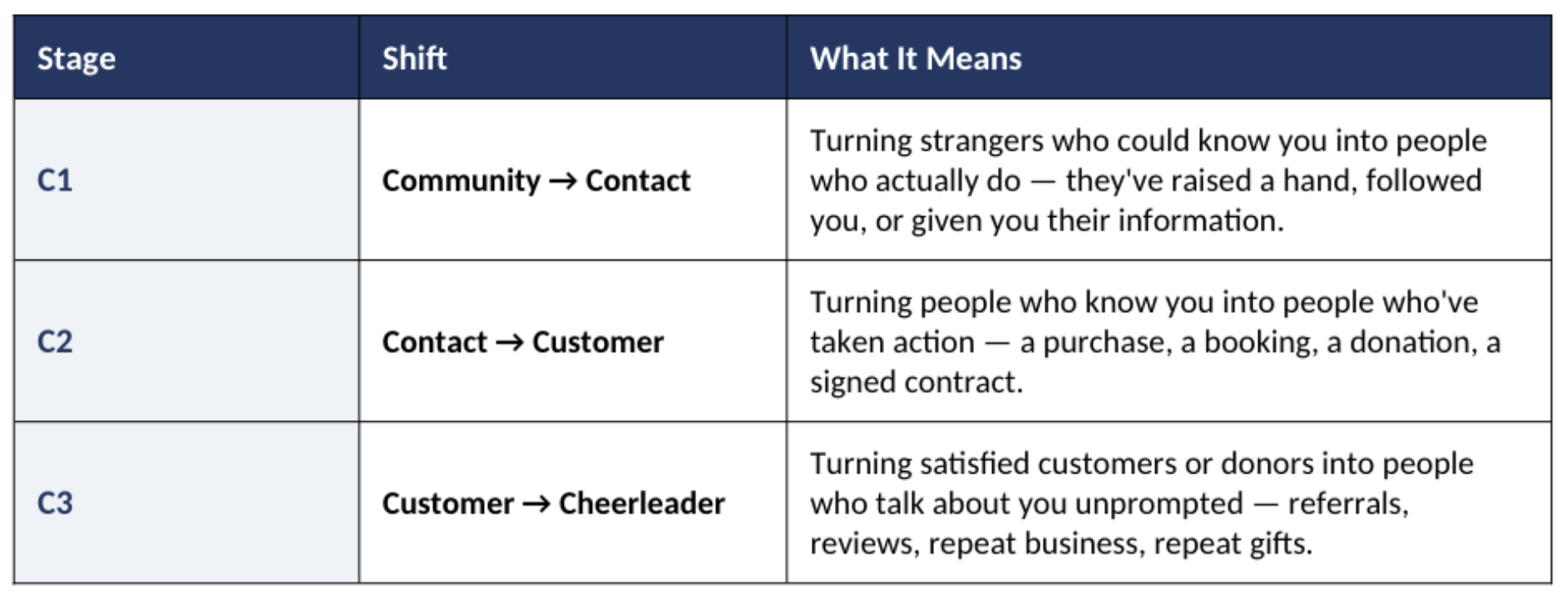
Turning satisfied customers or donors into people who talk about you unprompted — referrals, reviews, repeat business, repeat gifts.
Later lessons in this training will take each shift in turn. Lesson 1’s job is simpler: to establish that these are three distinct communication problems, and that treating them as one generic “marketing” effort is the single most common reason organizations lose people along the way.
Why This Matters Just as Much for Nonprofits
It's tempting to hear “customer” and assume this framework is only for businesses selling a product. In practice, nonprofits run through the identical sequence — just with different labels:
Community → Contact: A member of the public becomes a subscriber, follower, or event attendee.
Contact → Customer: A subscriber becomes a donor, volunteer, or program participant.
Customer → Cheerleader: A donor becomes a recurring giver, board advocate, or someone who brings others in.
The mission may be different from a business’s, but the relationship-building problem — and the cost of leaving it to chance — is exactly the same.
What It Costs an Organization to Skip This
The absence of a communication plan rarely shows up as one dramatic failure. It shows up as a slow leak — easy to miss month to month, expensive to ignore year over year.
Signs the Leak Is Already Happening
You can name where new leads or supporters come from, but not what happens to them next.
Your best customers or donors don’t hear from you unless they’re buying or giving again.
Referrals happen, but you couldn’t explain why or reliably repeat them.
Communication effort spikes around a launch or campaign, then goes quiet.
If the founder or director went on leave for a month, communication would largely stop.
Each of these is a symptom of the same root cause: relationships are being left to advance — or stall — on their own, instead of being deliberately moved forward.
What Changes When You Have a Plan
Every message has a job — you know which “C” it's meant to move someone through.
Effort compounds instead of resetting — this month builds on last month rather than replacing it.
The organization’s voice stays consistent even as different people communicate on its behalf.
You can tell what’s working, because you defined what “working” meant before you started.
New team members and volunteers have something concrete to follow, not just tribal knowledge.
Questions
Think of the last five communications your organization sent — emails, posts, calls, mailers. Which “C” was each one actually trying to move someone through? Could you tell?
Where in your organization does communication currently depend on one person remembering to do it?
If a new employee joined tomorrow, is there anything written down that would tell them how your organization communicates — or would you have to explain it from memory?
Action Step Before Lesson 2
Homework: Communication Audit
List every channel your organization currently uses to communicate (email, social platforms, phone, mail, events, in-person).
For each channel, note who it reaches: people who don’t know you yet, people who know you but haven’t acted, or people who’ve already bought or given.
Mark any channel where you’re not sure who it's really reaching, or what it's meant to accomplish.
Bring this list to Lesson 2 — it becomes the starting map for the Community → Contact stage.
Key Takeaways
• Every organization is already communicating; a plan decides whether that communication is working for you or by accident.
• Communication without a plan tends to become reactive, inconsistent, and dependent on one person.
• A communication plan answers who you’re reaching, what you want them to do next, how you’ll reach them, and how you’ll know it worked.
• The 3 C’s — Community to Contact, Contact to Customer, Customer to Cheerleader — are three distinct shifts, each requiring its own approach.
• This framework applies as directly to nonprofits and their donor journey as it does to businesses and their customer journey.