Read the homepage of almost any small or mid-size business and you'll find the same thing. A logo. A tagline. Then a paragraph that starts with "We."
We are a family-owned company. We have 25 years of experience. We offer a full range of services. We are committed to quality.
None of it is false. Most of it is genuinely earned. And almost none of it moves the person reading it.
Here's why: your customer didn't come to your website, open your email, or pick up your brochure to learn about you. They came because something in their world isn't working the way they want it to. Every sentence you spend describing yourself is a sentence you didn't spend on the only thing they actually care about — what happens to them if they choose you.
This blog is about making that shift.
The "Tell" Trap
Most businesses communicate from the inside out. It's natural. You know your company better than anything, you're proud of it, and when someone asks "what do you do?" the honest answer is a description.
So you end up with messaging that sounds like this:
"We provide comprehensive IT managed services."
"We're a full-service accounting firm."
"We specialize in commercial HVAC installation and repair."
"Our team has over 50 years of combined experience."
These are labels. They tell the customer which category you belong in. But a category is not a reason to choose you — every competitor is in the same category, saying nearly the same words.
The customer is left to do the hard part themselves: translating your services into what it would mean for their day, their budget, their stress level, their business. Most won't bother. They'll default to the cheapest option or the one they already know.
The Impact Shift
The alternative is to communicate from the outside in. Start with the customer's world, and describe what's different in it because of you.
Same businesses, flipped:
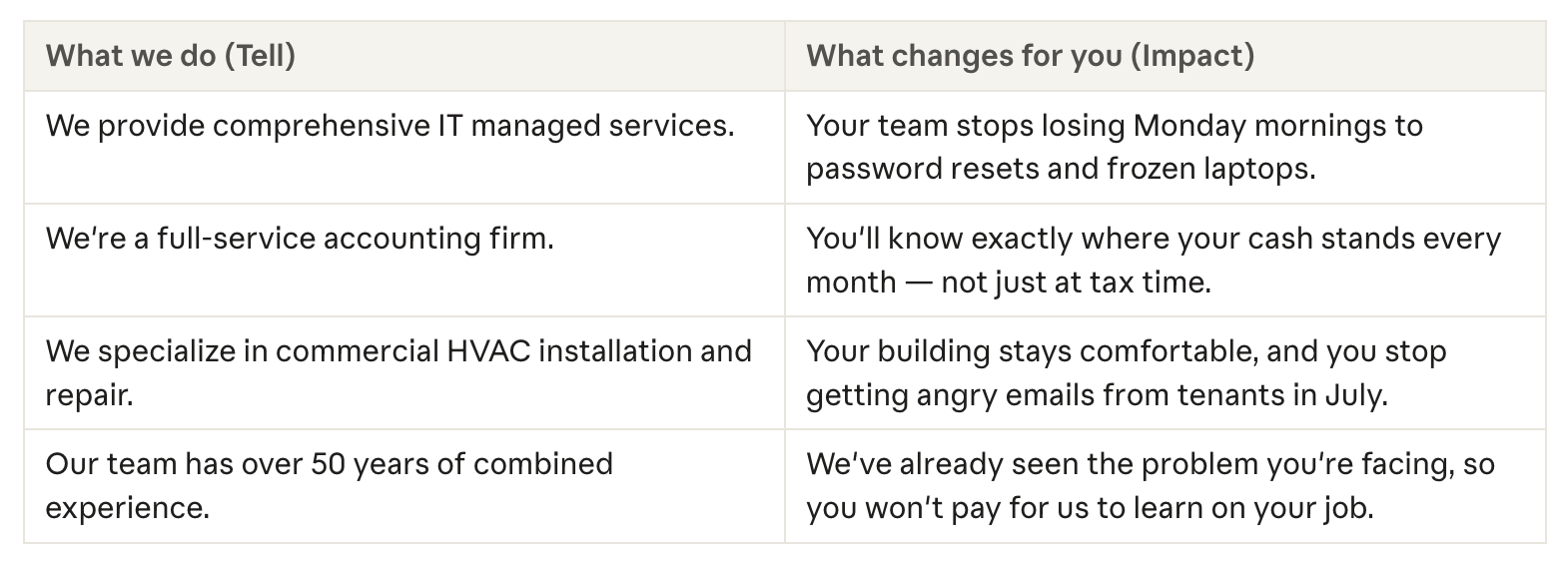
Notice what happened. The facts didn't change. The experience didn't disappear. It just got translated into a result the reader can picture.
Why This Works
People buy outcomes, not services. Nobody wants an accountant. They want to sleep at night knowing the numbers are right. The service is the vehicle; the outcome is the destination.
It lets the customer see themselves in the story. When you write "you," the reader is the main character. When you write "we," they're the audience watching someone else's story.
It differentiates you without bragging. Claiming you're "the best" invites skepticism. Describing a specific, believable change in someone's day earns trust.
It makes your experience matter. Credentials still count — but as proof that you can deliver the outcome, not as the headline.
A Simple Framework: Problem → Change → Proof
You don't need a brand agency to make this shift. Try rewriting any piece of communication with three questions:
Problem — What's frustrating, costly, or risky for them right now? Be specific. "Inefficiency" is vague. "Your office manager spends Friday afternoons chasing unpaid invoices" is real.
Change — What's different for them after working with us? Describe the after-picture in their language: time back, money saved, risk removed, stress gone, growth unlocked.
Proof — Why should they believe us? This is where your history, credentials, team and testimonials belong. They support the promise; they aren't the promise.
Before:
ABC Landscaping is a family-owned business serving the region since 1998. We offer lawn care, hardscaping, irrigation, and seasonal cleanup with a commitment to quality and customer satisfaction.
After:
Come home to a yard you're proud of — without giving up your weekends to keep it that way. We handle the mowing, the planting, the sprinklers and the fall cleanup, so all you have to do is enjoy it. Families in the area have trusted us to do exactly that since 1998.
Same company. Same services. Same 26 years. Completely different reason to call.
The "So What?" Test
Here's the fastest tool for catching "tell" language. Read each sentence of your website, proposal, email, or social post and ask: "So what?" Keep asking until you land on something the customer would actually feel.
"We use cloud-based software." → So what? → "You can see your records from anywhere." → So what? → "You can answer a client's question from your kid's soccer game instead of driving back to the office."
That last line is the one worth writing.
Where to Start
You don't have to rewrite everything at once. Start where customers form their first impression:
Your homepage headline. If it starts with your company name or "We," rewrite it around the customer's outcome.
Your "About Us" page. Yes, even this one. Make it about why your story matters to them — what your history means for the way you serve them.
Your elevator pitch. Replace "We're a ___ company" with "We help ___ so they can ___."
Your proposals and quotes. Open with the customer's goal, not your capabilities.
Your email signature and social bios. One line about the change you make beats a list of services.
A Quick Word Count Check
Take your homepage or your most recent marketing email and count two things: how many times you say "we," "our," or your company name, and how many times you say "you" or "your."
If the first number is bigger, you're telling. Flip the ratio and you'll be surprised how different your business sounds — even to you.
The Bottom Line
Your customers don't need to understand everything about your business. They need to understand what's different about their life, their work, and their business once you're in it.
Stop leading with who you are. Start leading with what changes for them. Your experience, your values and your story still matter — they just become the reason to believe, instead of the thing you're asking people to care about.
That's the shift. And in the posts ahead, we'll walk through exactly how to make it — one headline, one email, and one conversation at a time.